

1:59:40
What Kipchoge discovered on the other side of impossible.

The Inner Game of Eliud Kipchoge
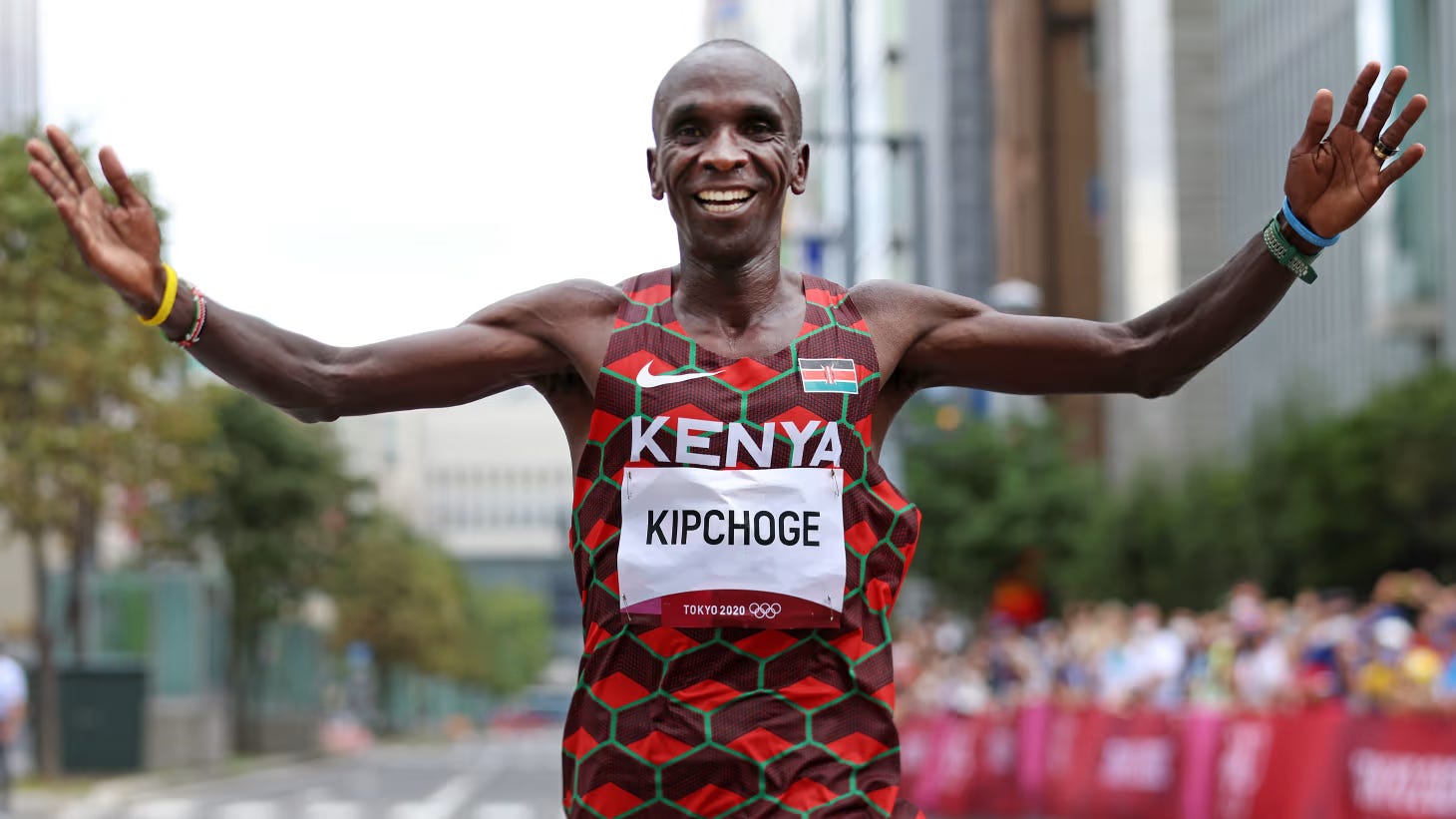
As runners descend on Boston and London for two of the world’s most storied marathons, tens of thousands will face the same invisible opponent. Not the course. Not the other competitors. The voice inside their own heads.
At mile 20, when quads burn and glycogen stores empty, that voice will whisper: Slow down. This hurts too much. You can’t do this.
Every marathoner knows this moment. When the body grows heavy, and the mind grows loud. That voice starts to whisper, Slow down. You’ve done enough, and it starts to sound reasonable.
The wall isn’t a place on the course; it’s a conversation in the mind.
Eliud Kipchoge has lived through that dialogue longer than anyone.
On October 12, 2019, in Vienna’s Prater Park, Eliud Kipchoge stood at a starting line facing a barrier no human had ever broken: the sub-two-hour marathon. For 26.2 miles, he would need to average 4:33.5 per mile, a pace that would win most local 5Ks. He would need to hold it for nearly two hours without a single moment of doubt.
The preparation for the event was surgical. Forty-one pacemakers rotated in and out in a precise V-formation, cutting wind resistance. A vehicle projected a laser beam on the ground to mark the exact pace. The course was flat, straight, and closed to traffic. Every controllable variable had been controlled.
But Kipchoge knew something the skeptics didn’t: the variables that mattered most couldn’t be engineered.
“If you don’t rule your mind,” he had said many times before, “your mind will rule you.”
The first few miles passed in eerie calm. Kipchoge floated behind his phalanx of pacers, his expression unchanged. He had run this race a thousand times in his head. He had visualized every kilometer, every breath, every moment when Self 1, the voice of judgment and fear, might try to intrude. Now all that remained was to let his body do what it already knew how to do.
He reached the halfway mark at 59:35, ahead of schedule.
The second half is where the cards are on the table and the truth comes out. When glycogen depletes, the muscles scream, and the mind searches desperately for reasons to stop. This is where Kipchoge lives: in the pain.
“I like the long runs,” he once explained, “because I am running for long. Makes my mind to really work hard for more than two hours. Makes me strong. It makes my mind strong, to be consistent, to respect that pain.”
Respect the pain. Don’t fight it or fear it, respect it.
At mile 20, the pacers began to fall away. One by one, they peeled off, leaving Kipchoge increasingly alone. By the final stretch, it was just him, the road, and the clock.
His face betrayed nothing, holding strong that same distant look and the same measured stride. The same impossible calm that had defined every major marathon he’d ever run.
Then, with a quarter-mile to go, something shifted. His mouth opened slightly. Not a grimace of pain, but something closer to disbelief. The corners of his lips turned upward.
He was going to do it.
Eliud Kipchoge crossed the finish line in 1:59:40.2, the first human being to run a marathon in under two hours. He raised his arms, not triumphantly, but in something more like offering. As if to say: See? This is what’s possible.
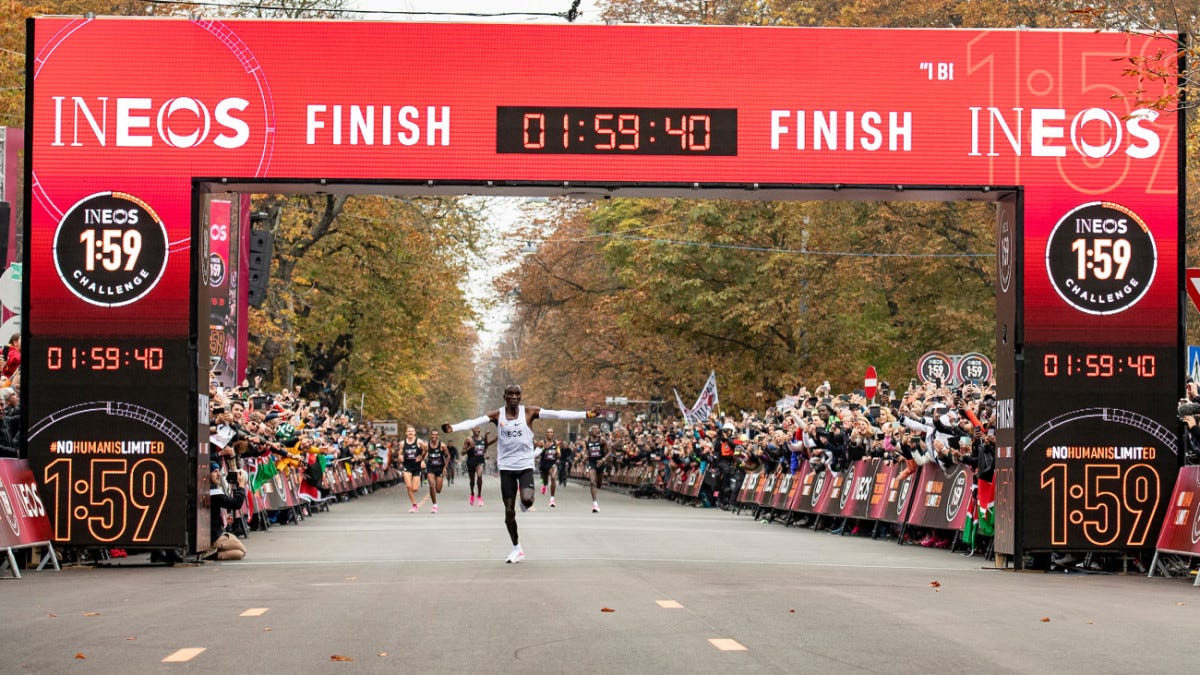
“I want to inspire the human race,” he said afterward. “No human is limited.”
The sub-two-hour marathon was not an official world record. The conditions were too controlled, too perfect. Critics dismissed it as an elaborate stunt, a moonshot with too many asterisks.
But they missed the point entirely.
Kipchoge wasn’t racing the clock, but the boundary of human belief. For decades, the two-hour barrier had been treated like the four-minute mile once was: a physical impossibility, a wall that the human body simply could not penetrate. Kipchoge treated it as what it actually was: just a story we told ourselves.
This is the inner game at its purest. Self 1 builds walls out of fear and doubt. Self 2 knows only what the body is actually capable of doing in this moment, with this breath, on this step. Kipchoge’s genius was learning to let Self 2 run the race while Self 1 stayed quiet.
“It’s believing in myself that’s made me really hit the wall and go across that wall,” he said.
His training reflects this philosophy. At his camp in Kaptagat, Kenya, Kipchoge lives with 24 other runners. They share meals. They share cleaning duties. The world’s greatest marathoner scrubs floors alongside teammates who may never win a major race. “When we are here,” one of his training partners explained, “we are not just athletes, but we are also learning about life.”
The distance from his ego to his performance is as vast as the Rift Valley horizon he runs beneath every morning. He has removed Self 1 from the equation. What remains is only the work, only the running, only the present moment.
“Pain is everywhere,” Kipchoge said, “but we say we win marathons in preparations, so the more you get a lot of pain, but you hit your targets in a good way.”
The more pain, the more progress. Not because suffering is virtuous, but because learning to be present with discomfort, without fighting it, without judging it, is the very skill that allows Self 2 to perform.
Even Kipchoge is not immune to defeat. At the 2024 Tokyo Marathon, he finished tenth, his lowest placement ever. The press called it a fall from grace, but Kipchoge called it a lesson.
“Defeat is important for me in that I will learn more. I will learn how to handle the negative part.”
Self 1 sees defeat as failure, as proof of limitation. Self 2 is only concerned with the information: What happened, what can be adjusted, and what comes next.
This is the practice that separates Kipchoge from every other marathoner alive: he has learned to observe his own performance without judging it. To watch the data without attaching his identity to the outcome. To run the mile he’s in.
At nearly 40 years old, he continues to train with the same discipline he brought to his first marathon. He wakes before dawn, runs the length of a marathon, reads in the camp library, and plants trees in fields that’ll inevitably outlive him. Then, he goes home on the weekends to play football with his sons.
His secret isn’t an incredible talent or gift; it’s just that he’s present.
Somewhere around mile 20 of Boston or London, hundreds of runners hit the wall. Their legs felt like concrete. Their lungs started to burn. Every voice in their head told them to stop.
In that moment, they had a choice. They could fight the pain, tense against it, and judge themselves for feeling it, or they could do what Kipchoge does.
Respect it, let it exist, and keep running.
Where in your own life are you fighting a wall that would disappear if you simply walked through it? What would change if you stopped judging the discomfort and started observing it?
Kipchoge’s Unfinished Business
Two weeks ago, John Korir shattered the Boston course record with a stunning 2:01:52, the fifth-fastest marathon ever run. Meanwhile, Eliud Kipchoge was absent from Hopkinton for the third consecutive year.
The last time Kipchoge stood on Boston’s starting line was April 2023, arriving as the heavy favorite to finally claim the one major marathon that had eluded him. By mile 20, something was wrong. His left leg wouldn’t respond the way it always had. The voice he had trained his entire career to quiet began to speak.
He finished sixth. His slowest marathon ever.
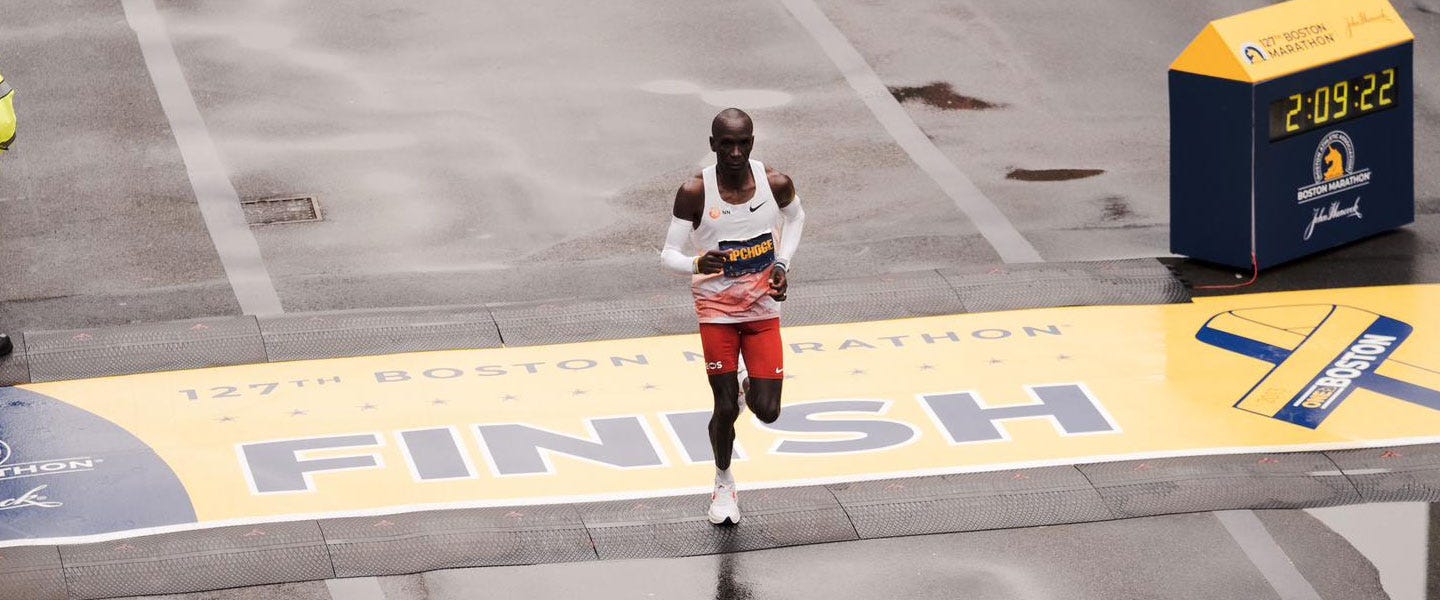
The next day, Kipchoge did something remarkable. He apologized.
“I promised that I would run a fruitful race. So I am sorry. Most of you were expecting me to win.”
When asked why he hadn’t dropped out despite the leg issue, his answer was pure Self 2: “Marathon actually is life. Resilience is one of the recipes for success. If you are not resilient then you cannot go anywhere.”
He could have framed the defeat as an asterisk, a fluke, something to explain away. Instead, he called it what it was: a lesson.
“Yesterday is a canceled check. Today is cash. And tomorrow is a promissory note. Let us forget about the canceled checks, let us talk of the cash and the promissory notes.”
Now 41, Kipchoge is in the final chapter of his elite career, planning to race the New York City Marathon this November as his last World Major. After that, he’s set his sights on something wilder: a marathon in Antarctica.
Even in stepping away from the spotlight, he’s still running toward the edge of what’s possible.
The Principle
Performance follows presence, not perfection.
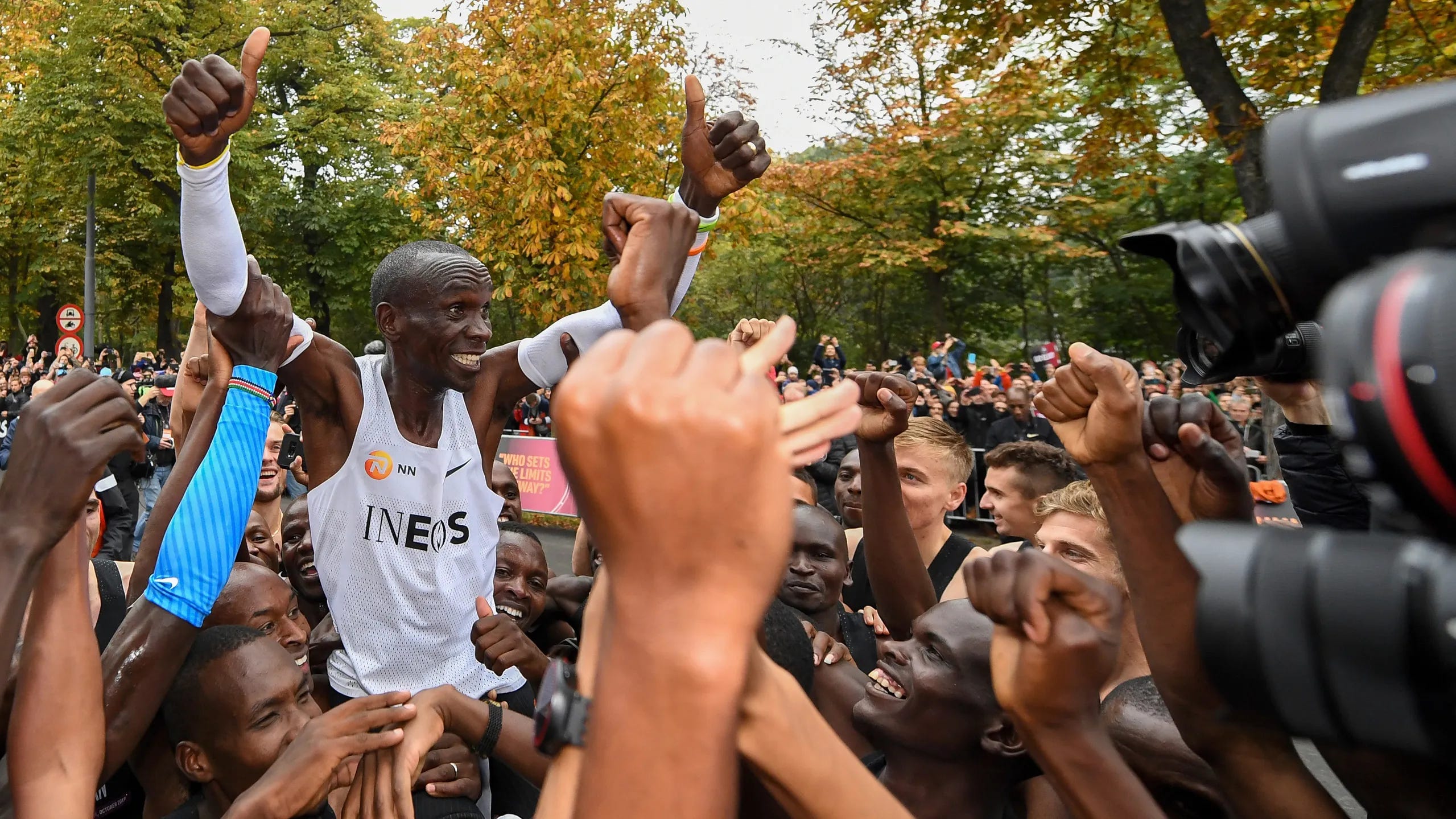
Kipchoge’s sub-two-hour marathon was the result of staying in the moment. He had trained his mind to trust his body, and to stop negotiating with doubt. When Self 1 tried to intrude with fear or judgment, he simply didn’t engage.
The wall, whether in a marathon or in life, is less about physical limitation than mental interference. When we stop fighting our discomfort and start observing it, we discover that the barrier was made of thought, not brick.
Practice
The next time you face a moment of sustained discomfort, whether in exercise, work, or a difficult conversation, try Kipchoge’s approach: respect the pain.
Instead of tensing against it or telling yourself you shouldn’t feel this way, acknowledge it directly. Say to yourself: This is what it feels like to do something hard. It’s supposed to feel like this.
Then ask: What would my body do if I let it?
Notice what happens when you stop commanding your performance and start allowing it.
The Legacy
“The player of the inner game comes to value the art of relaxed concentration above all other skills. He discovers that the secret to winning lies in not trying too hard.”
— Tim Gallwey, The Inner Game of Tennis
Kipchoge embodies relaxed concentration. His face remains calm through the final stretch. His shoulders stay loose. He trusts the preparation and lets Self 2 execute. The secret was removing the interference that would otherwise slow him down.
Invitation
Where is Self 1 building walls in your life this week? Hit reply and tell us what you’re noticing about the difference between fighting discomfort and respecting it.
Share this story with someone training for their own impossible milestone and give us a holler if you want early access to The Inner Game app in prep for a big performance or competition. Feedback so far is that it’s helping people quiet Self 1 so Self 2 can do the talkin’!